On December 13, at the St. Petersburg International Tourism Forum Travel Hub, a tripartite cooperation agreement was signed between the St. Petersburg Convention and Exhibition Bureau represented by General Director Sergei Azarenkov, the “Association of Communications Enterprises, Information Technologies and Digital Development” represented by Director Anton Paulich and the “BRICS Business Communications Center” represented by the Chairman of the Organizing Committee for the preparation and holding of the IMBRICS Forum Mikhail Cherepanov. The agreement is aimed at creating a Coordination Council (hereinafter referred to as the Coordination Council) under the auspices of the Convention and Exhibition Bureau of the Government of St. Petersburg – a unified system of interaction between the leaders of large city (regional) forums of St. Petersburg. The Council will become an important mechanism for jointly forming an annual plan of events, synchronizing them by date and building a common concept within which the forums will complement and strengthen each other, rather than compete for audiences and resources.
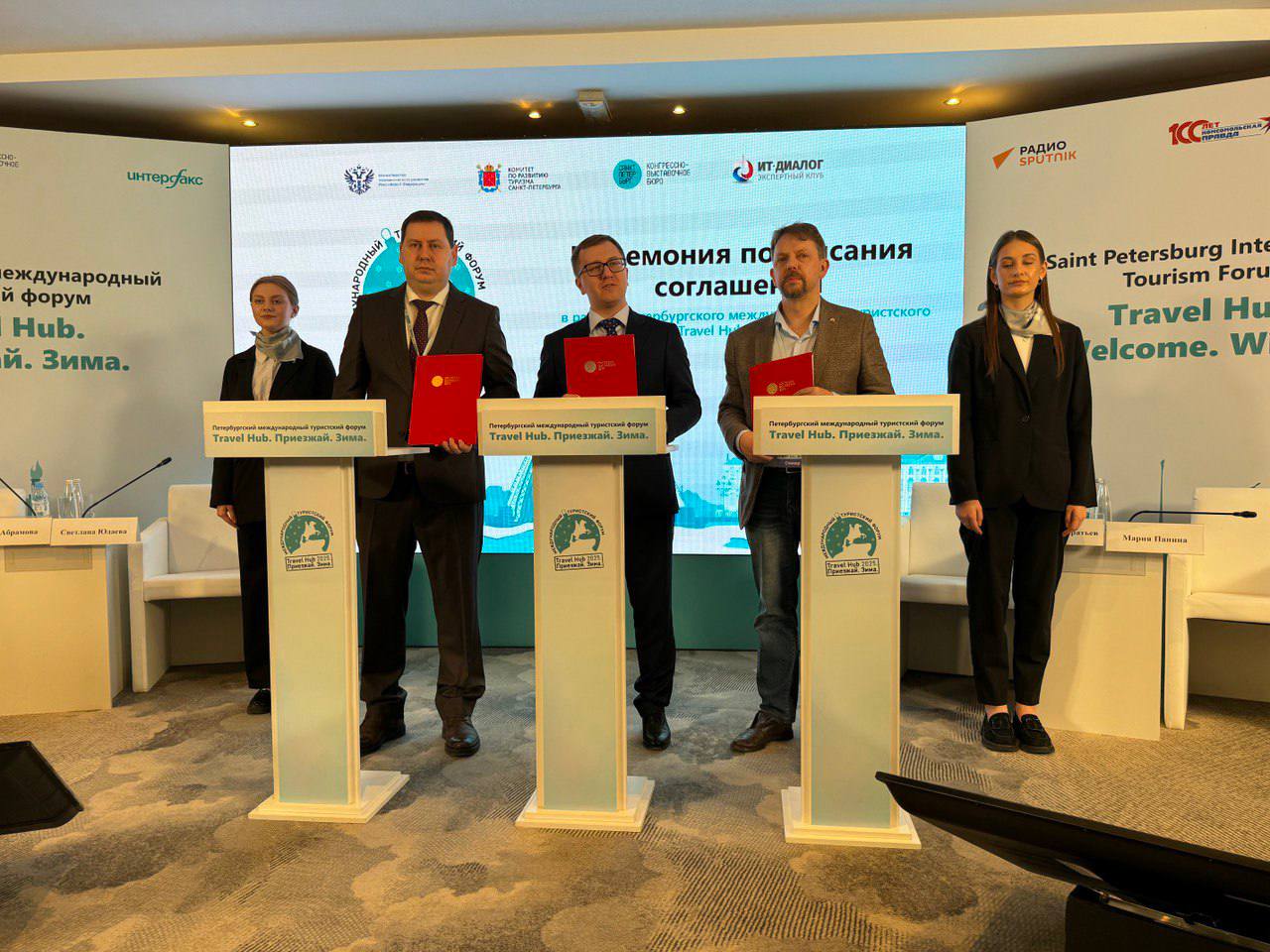
The use of the capabilities of the Convention and Exhibition Bureau, a subordinate institution of the Committee for Tourism Development of St. Petersburg, will be particularly important in this work, including existing agreements with hotels, airlines, airports and other participants in the tourism and transport industries. The formation of a unified support ecosystem for regional forums will allow organizers to receive comprehensive assistance from the structures of the Government of St. Petersburg and use existing tools for promoting and supporting events.
Centralized media coordination will be an important element of the Coordination Council work, both at the stage of preparing forums and after they are held. Joint information support and promotion of events abroad will help strengthen the business image of St. Petersburg in the regions of Russia and other areas of the world, as well as increase the recognition of the city.
A separate tool will be the formation of a register of events supported within the framework of the Constitutional Court. This list is planned to be used in international communications and mailings to cities with which St. Petersburg cooperates, which will increase interest from foreign participants and delegations.
The main goal of cooperation is to unite and consolidate all congress and exhibition activities of St. Petersburg, which will create an additional impetus for economic development, business tourism and strengthening the city’s international relations.
Centralized media coordination will be an important element of the Coordination Council work, both at the stage of preparing forums and after they are held. Joint information support and promotion of events abroad will help strengthen the business image of St. Petersburg in the regions of Russia and other areas of the world, as well as increase the recognition of the city.
A separate tool will be the formation of a register of events supported within the framework of the Constitutional Court. This list is planned to be used in international communications and mailings to cities with which St. Petersburg cooperates, which will increase interest from foreign participants and delegations.
The main goal of cooperation is to unite and consolidate all congress and exhibition activities of St. Petersburg, which will create an additional impetus for economic development, business tourism and strengthening the city’s international relations.
“The creation of the Coordination Council will make it possible to build systematic work with the largest business and socially significant events in St. Petersburg throughout the year. We are talking not only about synchronizing calendars, but also about forming a unified model for preparing such events, which will take into account the issues of accommodation of guests coming to the city for forums and congresses, transport logistics, work with catering establishments, and excursion companies. An important element will be well-established interaction with all relevant departments of St. Petersburg. As a result, St. Petersburg will be able to receive more tourists and attract more and more out-of-town and international participants, increasing the tourist flow by 13-17.5% per year. Coming to such events, city guests create additional demand for accommodation, food, transportation, visiting theaters and museums, purchasing souvenirs and much more - which directly supports small and medium-sized businesses in the relevant segments of our city’s economy,” emphasized Mikhail Cherepanov.
By the end of 2024, the tourist flow of St. Petersburg reached a record 11.6 million people, which far exceeds the level of 2023 and the pre-pandemic 2019 (10.5 million) – an increase of more than 23% by 2023. However, the share of business tourism, including participation in forums, conferences and exhibitions, is only a part – in 2024, business tourism in St. Petersburg remained at approximately 1.25 million people and has not shown significant growth in recent years.
The formation of the Coordination Council will allow us to move from disparate preparation of events to a managed system for the development of business tourism and increase this share. An increase in the number of participants at forums who come to St. Petersburg for more than one day and more often combine business trips with a cultural program is one of the goals of the Coordination Council, which began its consolidated activities at the end of 2025.
The formation of the Coordination Council will allow us to move from disparate preparation of events to a managed system for the development of business tourism and increase this share. An increase in the number of participants at forums who come to St. Petersburg for more than one day and more often combine business trips with a cultural program is one of the goals of the Coordination Council, which began its consolidated activities at the end of 2025.